The 2026 time zone change, explained
On Nov 1, 2026, British Columbia, Alberta, Manitoba and the Northwest Territories stopped changing their clocks. The rest of Canada and almost all of the US didn't. Here's who's on what time now, the towns that break the rules, and whether anyone else is following.
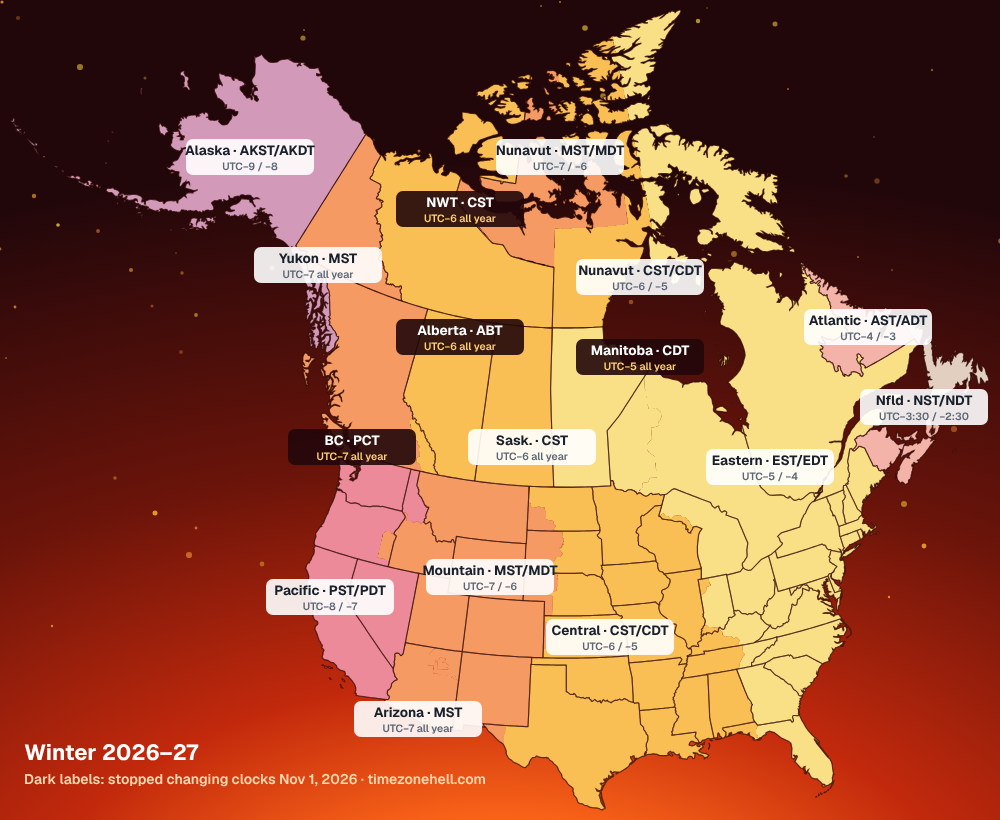
What changed
| Where | Time now | What happened |
|---|---|---|
| Most of British Columbia | UTC−7 all year | Moved its clocks forward one last time on March 8, 2026, then stayed there. BC calls it Pacific Time. |
| Alberta | UTC−6 all year | Didn't fall back on Nov 1, 2026. The province calls it Alberta Time. |
| Northwest Territories | UTC−6 all year | Followed Alberta. |
| Manitoba | UTC−5 all year | Didn't fall back on Nov 1, 2026. |
| Northwestern Ontario (Kenora) | UTC−5 all year | Follows Manitoba, as it always has. |
| BC's East Kootenay (Cranbrook, Fernie) | UTC−6 all year | Follows Alberta, as it always has. |
| Golden, BC | UTC−7 all year | Switched from Alberta's time to BC's. |
What didn't change
Already on one time all year: Yukon (UTC−7), Saskatchewan (UTC−6), BC's Peace River region and Creston (UTC−7), Arizona outside the Navajo Nation (UTC−7) and Hawaii (UTC−10).
Still changing twice a year: the rest of Ontario, Quebec, Atlantic Canada, Newfoundland and Labrador, Nunavut and the rest of the US. Their next changes are March 14, 2027 and Nov 7, 2027.
See every exception on the odd ones out list.
What it means in practice
| Between | Winter | Summer |
|---|---|---|
| Vancouver and Seattle | Seattle 1h behind | Same time |
| Vancouver and Toronto | Toronto 2h ahead | Toronto 3h ahead |
| Calgary and Denver | Denver 1h behind | Same time |
| Winnipeg and Chicago | Chicago 1h behind | Same time |
| Winnipeg and Toronto | Same time | Toronto 1h ahead |
| Vancouver and Calgary | Calgary 1h ahead | Calgary 1h ahead |
| Vancouver and London | London 7h ahead | London 8h ahead |
Use the calculator for any other pair, or browse all 78 comparisons.
Is your phone or computer ready?
This needs JavaScript turned on.
Will anyone else follow?
Is California going to stop daylight saving time?
Not yet. California voters approved Proposition 7 in 2018, which lets the state legislature move to permanent daylight time, but permanent daylight time also needs approval from Congress. That hasn’t happened, so as of October 2026 California still changes its clocks twice a year.
Will Washington and Oregon follow BC?
They want to. Washington passed a law in 2019 to adopt permanent daylight time, and Oregon passed a similar one, but both only take effect if Congress allows it. Until then, Seattle and Portland keep falling back, which puts them an hour behind Vancouver from November to March.
Is the US going to make daylight saving time permanent?
Maybe. The House of Representatives passed the Sunshine Protection Act (H.R. 139) on July 14, 2026, by 308 to 117, and the President supports it. The Senate hasn’t voted on it as of October 2026. If it becomes law, most US states would stop changing their clocks and line up with BC and Alberta again all year.
Will Ontario stop changing its clocks?
Only partly, for now. The parts of northwestern Ontario that already use Manitoba’s time, including Kenora, are following Manitoba and not falling back. Ontario passed a law in 2020 to make daylight time permanent for the whole province, but it only takes effect if Quebec and New York do the same.
Will Quebec stop changing its clocks?
Not soon. Quebec has asked the public, and most people said they want to stop changing the clocks, but the government hasn’t set a date and is not expected to move without its neighbours.
What about Saskatchewan and Yukon?
Nothing changes. Saskatchewan has stayed on UTC−6 all year for decades, which now matches Alberta. Yukon has been on UTC−7 all year since 2020, which now matches BC.
Why did BC pick daylight time instead of standard time?
BC passed its law in 2019 planning to move alongside Washington, Oregon and California, which all chose permanent daylight time. After years of waiting on Congress, BC went ahead on its own in 2026. Daylight time means later sunsets all year, at the cost of darker winter mornings.
Has anywhere else done this?
Yes. Mexico stopped changing its clocks in 2022, apart from some cities along the US border. Within North America, Arizona and Hawaii have skipped daylight saving time for decades.
Will my phone change automatically?
Only if it has the latest software and location-based time zone is turned on. Check your device here.
What happens to meetings in my calendar?
Meetings booked before your calendar knew about the change can show an hour off after Nov 1, especially in Outlook. The organizer should open the meeting and save it again in the current time zone.
Sources, current as of October 2026: Province of BC · Microsoft · The Weather Network · HR Reporter · House Energy & Commerce Committee · MyNorthwest · CTV News · UBC IT